Artist Journal
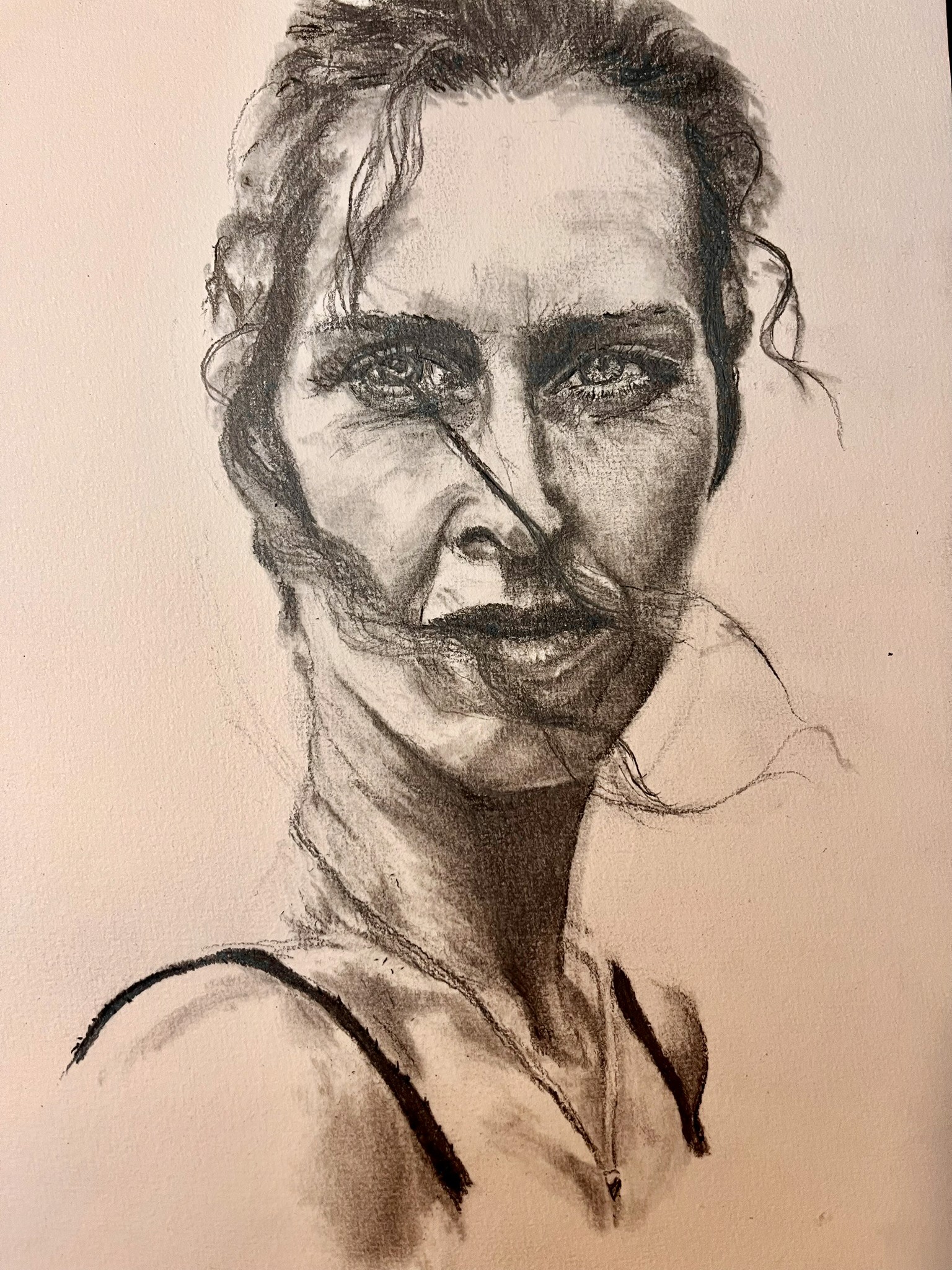
I recently discovered something about the Hebrew word for face that stayed with me.
Panim — פנים — is grammatically plural.
Even when referring to the face of a single person, the word itself carries plurality.
I like this idea enormously.
Perhaps because it comes close to what has always fascinated me when I draw faces. I am rarely interested in simply reproducing someone’s features. What interests me is what seems to pass through them: experience, emotion, intention, motivation, fatigue, desire, defiance, vulnerability, energy. Sometimes something more difficult to name — a quality of the soul.
A face can contain several of these things at once.
And the same face changes continuously. Age changes it. Love does. Loss does. Ambition, disappointment, illness, exile, confidence, fear, knowledge — all leave something behind. We carry our lives on our faces, but never in a completely legible way.
Perhaps this is why Romain Gary has fascinated me for so long.
Few biographies I know seem to contain so many lives inside one existence.
He began as Roman Kacew, born in Wilno into a Jewish family, moving through Russian and Polish worlds before arriving in France as a teenager. He became French. He became an aviator and joined the Free French Forces when France fell in 1940. He became a war hero. Then a diplomat. A novelist. A filmmaker. A public figure.
And then he did something even more extraordinary.
Having already become Romain Gary — itself an identity shaped from Roman Kacew — he created Émile Ajar, a second literary existence. Gary had already won the Prix Goncourt. Years later, La Vie devant soi, published under the name Émile Ajar, won it again. For a time, the literary world believed these were two different writers.
There were still other names, other masks, other voices.
But I do not see this multiplicity simply as disguise.
I see freedom in it.
To inherit several cultures, to cross languages and countries, to move through different social worlds, professions and identities, is to acquire something that cannot simply be bought.
Cultural richness is not a collection of references. It is lived experience.
Part of it is given to us by circumstance; part of it we build intentionally through curiosity, movement, reading, relationships and the refusal to remain confined to a single definition of ourselves.
Gary seems to have understood this almost instinctively.
He did not live one life consistently.
He lived several lives intensely.
Perhaps this is what I am looking for when I draw a face.
Not the expression.
Not the identity.
Not even the person.
I am looking for the coexistence of all the people that person has been, could have been, still wants to become — and occasionally the trace of something underneath them all.
Maybe the Hebrew language has accidentally given me the word for it.
Panim.
The face, in the plural.